
What Mille Lacs County Court Dockets Show
A docket is the court's running list of case events. In Mille Lacs County District Court, a docket can point to the case number, party name, hearing date, time, courtroom, judicial officer, hearing type, and connection type. In a full case view, the docket also appears as the Register of Actions, which is the chronological list of filings, notices, orders, hearings, dispositions, and financial events. It tells the reader what the court has recorded, but it does not always include the full text of every document.
Mille Lacs County is part of Minnesota's Seventh Judicial District. The District Court has original jurisdiction over civil, family, probate, juvenile, criminal, traffic, and conciliation cases filed in the county. Because Minnesota uses a unified trial court, the docket source is not split among separate county, justice, or municipal courts. City police departments may issue citations, and tribal courts may have separate jurisdiction in tribal matters, but county District Court dockets are searched through Minnesota Judicial Branch systems and local Court Administration.
- Docket entry
- A single recorded event on the case activity list.
- Register of Actions
- The chronological case history in MCRO case details.
- Hearing type
- The court event label, such as bail hearing, omnibus hearing, review hearing, or scheduling conference.
- Connection type
- The calendar field that may show whether the hearing is in person, remote, or otherwise listed by the court.
Find Mille Lacs County Court Dockets
The official online route for hearing information is MCRO Hearing Search. It can search by name, case number, judicial officer, or attorney. When the exact file is known, the case-number path avoids many false matches. When only a party name is known, the county filter should be set to Mille Lacs County unless there is a reason to search all Minnesota District Courts.
The MCRO Hearing Search interface is the assigned hearing lookup screen for Mille Lacs County court dockets.
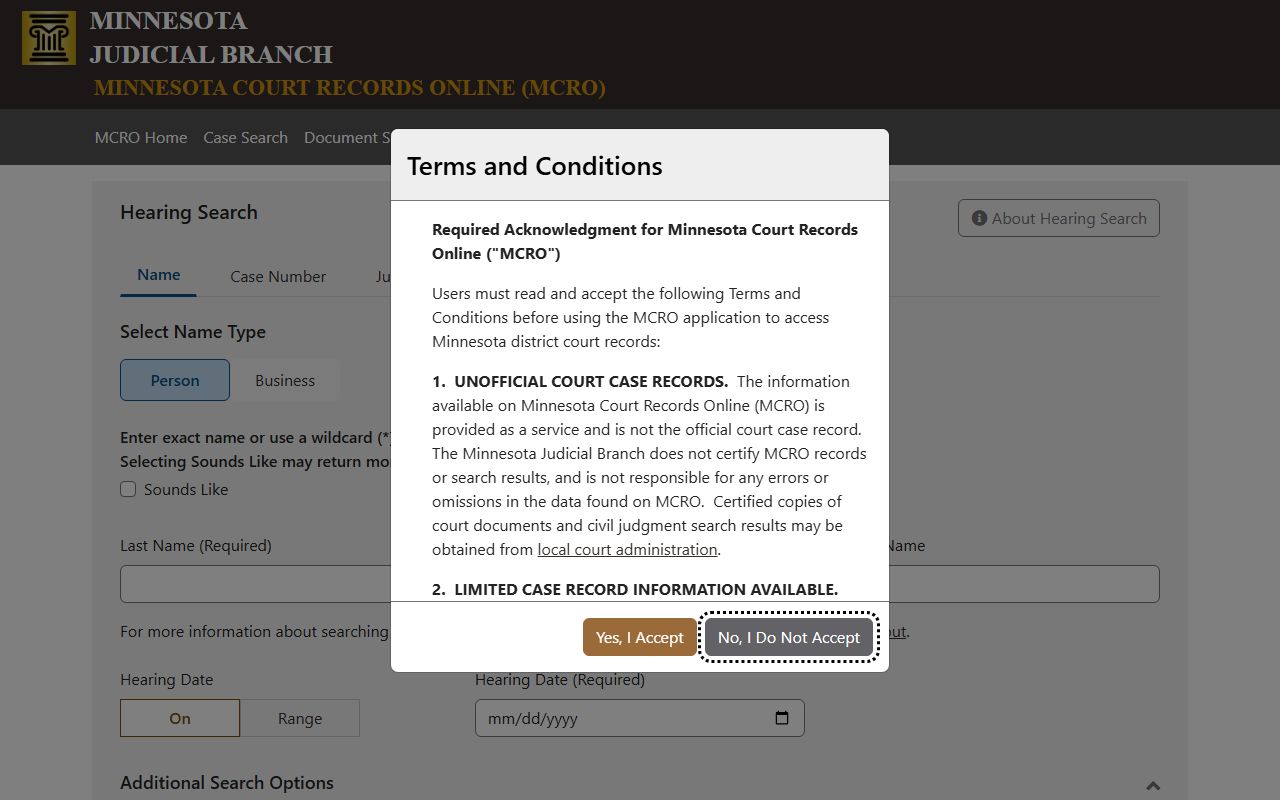
That screen is best for scheduled hearings, while Case Search is better when the reader needs the broader case activity list and available documents.
- Open MCRO Hearing Search and choose the search tab that matches the information available.
- Use Case Number for a known file, Name for party searches, Judicial Officer for a judge-based calendar, or Attorney for counsel-based searching.
- Select Mille Lacs County in the court-location filter when the case is local.
- Review the hearing date, time, location, hearing type, judicial officer, and case number.
- Open the related case in MCRO Case Search when docket events, dispositions, or public documents are needed.
- Contact Court Administration if the hearing is missing, confidential, sealed, too recent, or needs confirmation before travel.
Mille Lacs County Docket Fields
The research captured a public calendar field inventory from the Mille Lacs County District Court calendar link and MCRO hearing tools. The daily calendar can include courtroom hearings, but it does not prove that every matter handled by the court is posted online. Confidential matters, restricted matters, and records not remotely accessible under public-access rules may be absent. Printed calendars at the courthouse can be more current for same-day courtroom changes.
| Field | What It Shows |
|---|---|
| Party Name | The public party name tied to the scheduled hearing or docket event. |
| Hearing Location | The court location or courtroom, with examples including Courtroom 1 and Courtroom 2. |
| Hearing Date | The date set for the court event. |
| Time | The scheduled hearing time. |
| Judicial Officer | The judge or officer assigned to the hearing. |
| Hearing Type | Labels such as default hearing, omnibus hearing, review hearing, bail hearing, pre-trial, or initial appearance. |
| Connection Type | The calendar field indicating the listed appearance format. |
| Case Number | The District Court file number, such as a 48-CR, 48-CV, 48-FA, or 48-JV case. |
Public snippets identified judicial officers including Mark J. Herzing, Gail T. Kulick, Gary R. Larson, and Matthew M. Quinn. A judicial officer name in a docket is a scheduling field, not a final ruling. The outcome is found in later docket entries, orders, disposition entries, judgment entries, or sentencing records when those records are public.
Mille Lacs County Court Dockets Online
The Minnesota Judicial Branch MCRO overview explains the online search tools available for District Court case information.
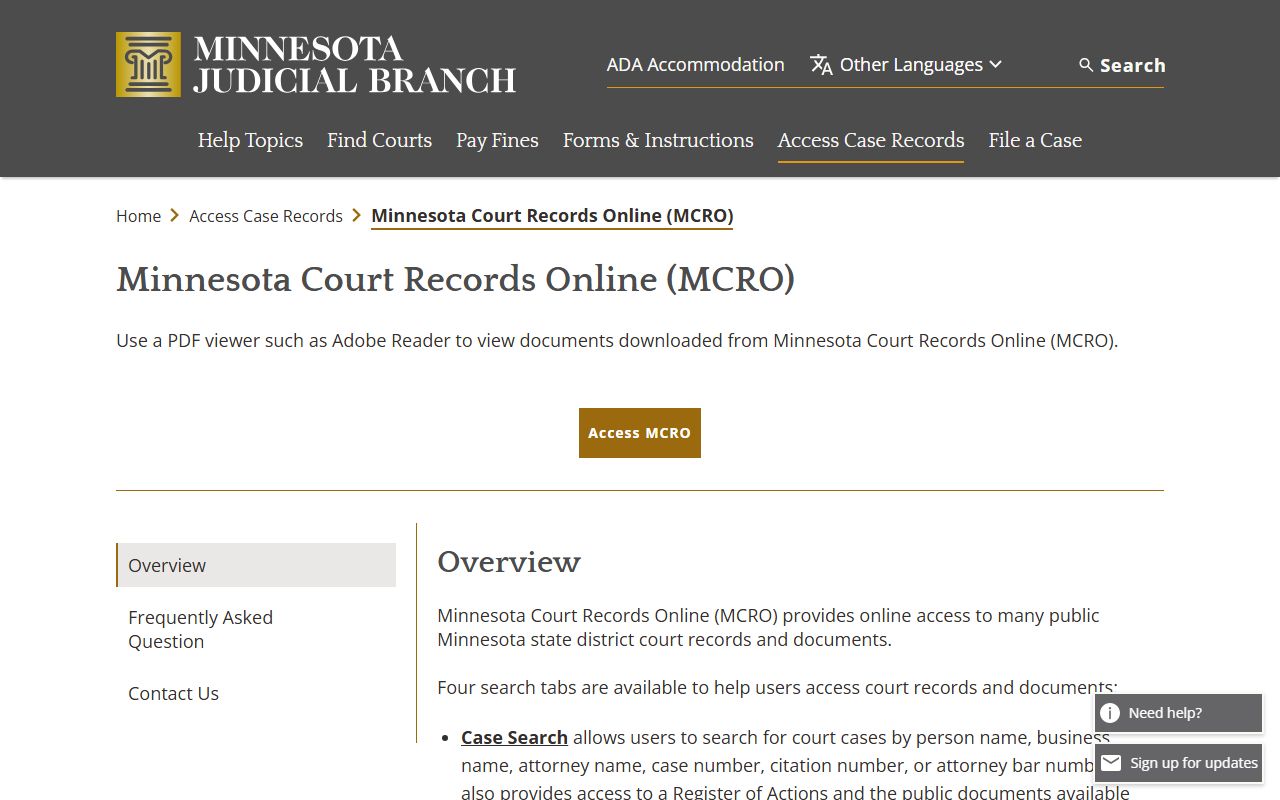
For Mille Lacs County court dockets, the overview helps separate Case Search, Document Search, Hearing Search, and Judgment Search so the reader chooses the right path.
Mille Lacs County does not have separate county courts or justice courts for ordinary case dockets. The local District Court hears civil, criminal, family, probate, juvenile, traffic, and conciliation matters. The County Attorney, Court Security, County Jail, and County Recorder each connect to the justice system in different ways, but they do not publish the District Court docket. The County Recorder's office is relevant for marriage, vital, military discharge, and real estate records, not case calendars.
- MCRO Hearing Search is the best online tool for upcoming hearing lookups.
- MCRO Case Search is the better tool for the Register of Actions and case-level docket history.
- MCRO Document Search works only when a case number is known and public documents are available online.
- MCRO Judgment Search supports debtor-name searches for docketed money judgments.
- Court Administration is the local confirmation point for certified copies, courthouse access, and records that are not remotely available.
Mille Lacs County Dockets vs Case Records
A docket is a map of case activity. A full court record is the file behind that activity. In Mille Lacs County, a criminal docket might show a complaint filing, bail hearing, omnibus hearing, plea, sentencing, and financial entries. The full record may include the complaint, public orders, sentencing documents, and other available documents. In a civil case, the docket may list the complaint, answer, motions, orders, and judgment, while the document record may hold the filings themselves if online access is allowed.
| Point of Comparison | Docket | Full Case Record |
|---|---|---|
| Main purpose | Tracks events and hearings. | Shows case data and filed documents when public. |
| Common fields | Dates, hearing types, parties, judicial officer, case number. | Parties, filings, orders, documents, dispositions, sentences, financials. |
| Best online tool | MCRO Hearing Search or Case Details. | MCRO Case Search and Document Search. |
| Certified use | Not a certified record by itself. | Certified copies come from Court Administration. |
| Limits | Confidential and restricted hearings may not appear remotely. | Some documents are unavailable online or redacted. |
For broader case research, the full Mille Lacs County court records search belongs in Mille Lacs County court records. For dockets, focus first on hearing date, court location, case number, and the event label.
Mille Lacs County Docket Access Limits
The Minnesota Rules of Public Access control which court case records are accessible and which records can be shown remotely. The Minnesota Rules of Public Access table of contents is the official rule source tied to court-record access.
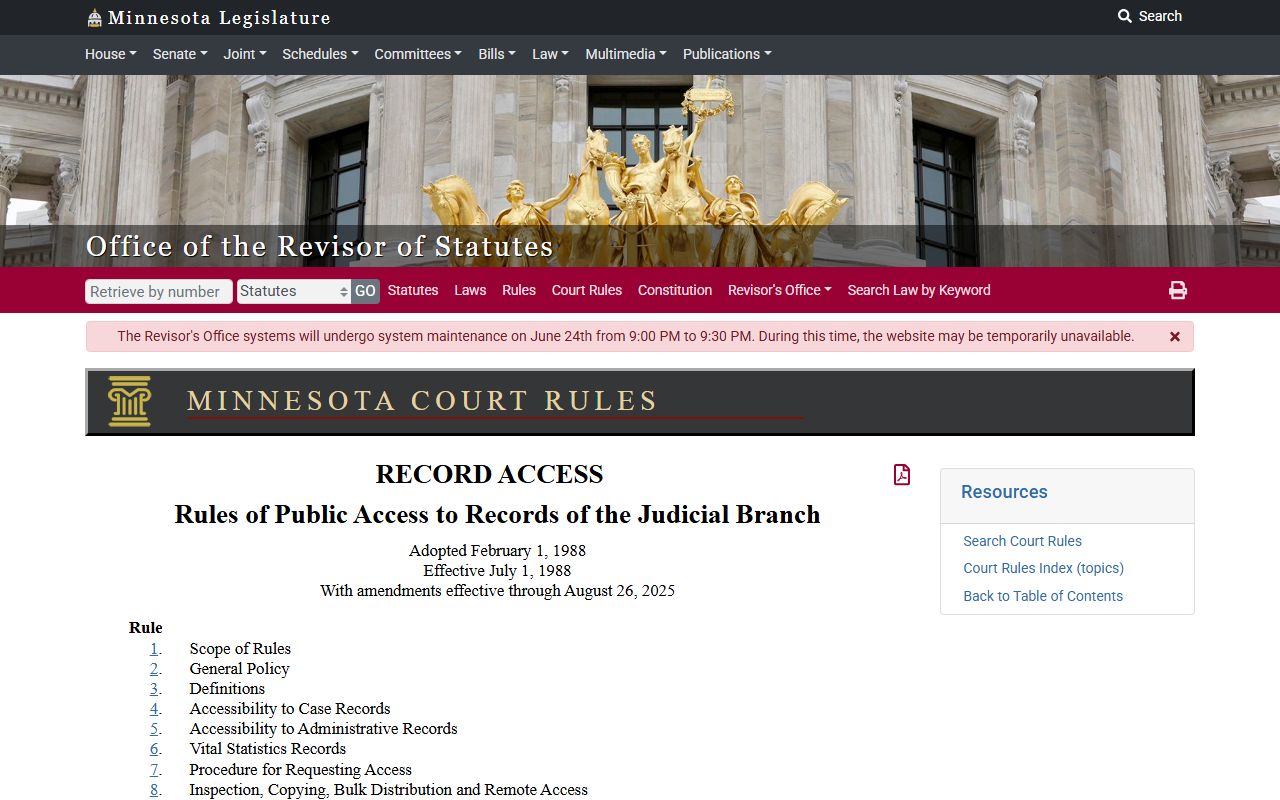
Those rules explain why a public case may still have fewer details online than at the courthouse or why a docket is absent from remote search.
MCRO restrictions are practical, not just technical. Domestic abuse Order for Protection and harassment restraining order cases are restricted from internet display because of federal VAWA concerns. Civil commitment records, many juvenile records, adoption records, sealed records, expunged records, party street addresses, and many comment fields are not general remote lookup material. Pending criminal, traffic, and petty misdemeanor cases without conviction may fail under a defendant-name search but may still be found by case number when public access permits.
Note: A missing online docket does not prove that a hearing was cancelled or that a case does not exist.
Read Mille Lacs County Docket Entries
Start with the case number. A number beginning with 48 identifies Mille Lacs County in public examples. The case-type code gives context: CR is criminal, CV is civil, FA is family, JV is juvenile, and PR is probate. Next, read the hearing type. A bail hearing concerns release conditions. An omnibus hearing is a Minnesota criminal pretrial hearing. A scheduling conference sets dates and deadlines. A review hearing checks compliance, probation, treatment-court progress, or another court order depending on the case.
The docket should be read in order. A charge, motion, or hearing entry is not the same as a final disposition. A continuance means a hearing or deadline was moved. A dismissal ends a claim or charge on that item. A judgment is a final decision or money obligation. A sentence follows a conviction in a criminal case. When wording is unclear, use the case details, available documents, and Court Administration rather than guessing from a single docket line.
Calendar entries also need date context. The Mille Lacs County District Court page links to a weekly public court calendar PDF that is posted at 7:00 a.m. each business day and updated hourly. That calendar is useful for checking the day's courtroom schedule, but the research warning is clear: scheduled courtroom hearings are reflected, not every matter handled by the court. Absence from the calendar should be checked against MCRO case details or Court Administration before anyone assumes a hearing is gone.
Mille Lacs County Court Administration
225 6th Avenue SE
Milaca, MN 56353
320-362-3200
Monday-Friday, 8 a.m.-4:30 p.m.
Use that office for same-day local confirmation, certified copies, and public terminal access. The online docket is helpful, but courtroom calendars can change, and official notices or court orders control the parties' duties.