
Mille Lacs County District Court Overview
Mille Lacs County District Court is Minnesota's unified trial court at the county level. The Minnesota Judicial Branch states that the court has original jurisdiction in all civil, family, probate, juvenile, criminal, and traffic cases filed in Mille Lacs County. The county Court Administration page adds that Mille Lacs is one of ten District Courts in the Seventh Judicial District and that three judges are chambered in Milaca. This structure is important because the county does not have a separate county court, justice court, municipal court, or elected clerk handling ordinary trial-court case files.
The local court address is the Mille Lacs County Justice Center, 225 6th Avenue SE, Milaca, MN 56353. The phone number is 320-362-3200. Office hours are Monday through Friday, 8 a.m. to 4:30 p.m. Free public surface lot and free on-street parking are listed by the Minnesota Judicial Branch. Court security is strict: the county Court Security page says no firearms, weapons such as pocket knives or pocket tools, or cellular telephones are allowed in the Justice Center.
Mille Lacs County District Court
225 6th Avenue SE
Milaca, MN 56353
320-362-3200
Monday-Friday, 8 a.m.-4:30 p.m.
Mille Lacs County District Court Offices
Because Minnesota uses one District Court trial court, the local table is best understood as a court and court-related office map rather than a list of separate numbered courts. District Court, Court Administration, Court Security, the County Attorney, the County Jail, and the Recorder may all matter to a records search, but they do different work. Court Administration handles court case support. The County Attorney prosecutes many criminal matters. The jail handles custody. The Recorder handles county records outside the court file.
| Court / Office | Type | Address | Phone |
|---|---|---|---|
| Mille Lacs County District Court | Unified trial court | 225 6th Avenue SE, Milaca, MN 56353 | 320-362-3200 |
| Court Administration | Case processing and court support | 225 6th Avenue SE, Milaca, MN 56353 | 320-362-3200 |
| Court Security | Security and transport | Justice Center / Sheriff's Office function | 320-983-8366 |
| County Attorney | Prosecution and county civil counsel | 225 6th Avenue SE, Milaca, MN 56353 | 320-983-8305 |
| County Jail | Pretrial and sentenced custody | 640 3rd Street SE, Milaca, MN 56353 | 320-983-8244 |
| County Recorder | Marriage, vital, and real estate records | 635 2nd Street SE, Milaca, MN 56353 | 320-983-8205 |
Mille Lacs County District Court Case Types
The District Court handles case types that many states split across several courts. Civil records can include complaints, answers, motions, orders, judgments, settlement notices, and enforcement entries. Criminal records can include complaints, filed charges, bail hearings, omnibus hearings, pleas, verdicts, dispositions, sentences, probation conditions, fees, fines, and restitution. Family cases include divorce, custody, parenting time, child support, paternity, and domestic-related matters. Probate case types include formal probate, other probate, guardianship, conservatorship, and trust cases.
Traffic and petty misdemeanor matters are also District Court records in Mille Lacs County. Citation payment and lookup may use Minnesota Court Web Payment, while broader case details use MCRO. Juvenile and mental health cases require care because public access is limited. Juvenile delinquency files are generally confidential, with limited public access for some felony-level cases involving a juvenile who was at least sixteen at the time of the alleged offense.
- Civil and conciliation cases use District Court case numbers and MCRO public access where allowed.
- Criminal cases are prosecuted in District Court after charging by the appropriate prosecuting authority.
- Family and divorce files are District Court records, while marriage certificates are Recorder or MOMS records.
- Probate estates, guardianships, conservatorships, and trusts are District Court case types.
- Traffic and petty misdemeanor citations route to District Court records and payment systems.
District Court vs Other Local Forums
Mille Lacs County records are easiest to understand by separating the District Court from other government forums. Minnesota District Court is the county trial court. Municipal police departments may issue citations, but the traffic or criminal court case is a District Court matter. The Mille Lacs Band of Ojibwe has a separate District Court for matters within tribal jurisdiction, and that court is not the Mille Lacs County District Court. Federal courts also operate separately from county court.
| Forum | Role | Record Source |
|---|---|---|
| Mille Lacs County District Court | Unified Minnesota trial court for civil, criminal, family, probate, juvenile, traffic, and conciliation matters. | MCRO and Court Administration. |
| Municipal police citation source | May issue tickets or refer criminal matters. | The filed court case routes to District Court systems. |
| Mille Lacs Band of Ojibwe District Court | Separate tribal court for tribal jurisdiction matters. | Tribal court channels, not county District Court. |
| Federal District or Bankruptcy Court | Federal crimes, federal civil cases, bankruptcy, and federal appeals path. | PACER and federal court systems. |
| County Recorder | Vital, marriage, military discharge, notary, and land records. | Recorder office and Recorder portals. |
Mille Lacs County District Court Case Flow
A case moves through different stages depending on the case type. Criminal cases may begin with an investigation and charging document, then move through first appearance, bail or release conditions, omnibus or pretrial hearings, plea or trial, disposition, sentencing, and possible appeal. Civil cases usually begin with a complaint or petition, then move through service, answer, motions, scheduling, settlement, trial or judgment, and possible appeal. Family, probate, juvenile, traffic, and conciliation cases have their own event labels, but the court record still sits in District Court.
Criminal flow: Charge filed › First appearance › Bail or release conditions › Omnibus or pretrial hearing › Plea or trial › Disposition › Sentencing › Appeal.
Civil flow: Complaint or petition filed › Service › Answer or response › Motions and scheduling › Settlement or trial › Judgment › Appeal.
Appeals from a final District Court order or judgment usually go to the Minnesota Court of Appeals unless a statute or rule sends the matter directly to the Minnesota Supreme Court. Further review by the Supreme Court is discretionary in many case types.
Mille Lacs County District Court Records
MCRO is the official remote access system for many Minnesota District Court records. Case Search can search by name, case number, citation number, or attorney. Document Search requires a case number and is used for available public documents. Hearing Search supports the local docket and calendar workflow. Judgment Search supports debtor-name judgment lookups. Certified copies and certified civil judgment search results come from local court administration, not from a self-printed online page.
The MCRO Document Search screen is assigned to the Mille Lacs County District Court page because document access depends on knowing the court case number.
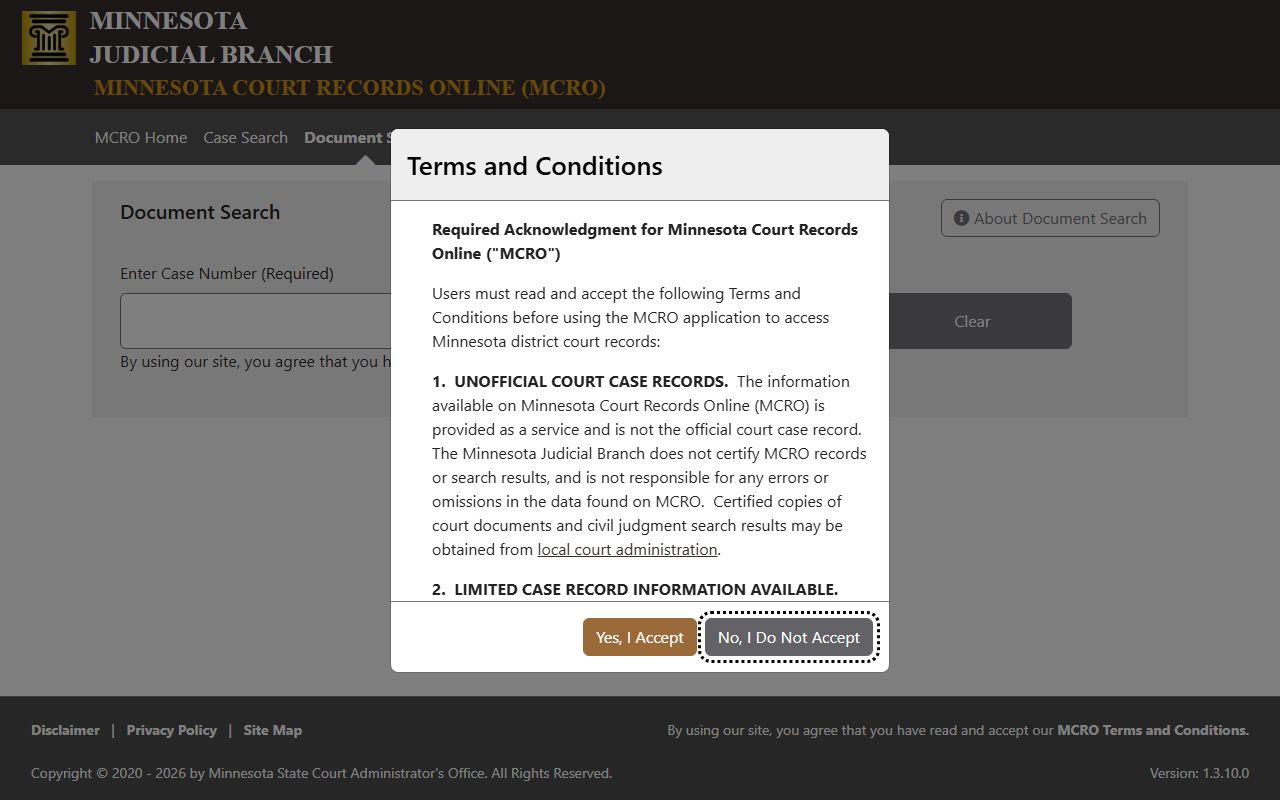
Document Search is narrow by design. It helps after the case is identified, while Case Search and Hearing Search are better starting points when the case number is not known.
Remote access does not equal full public access. Some public courthouse-terminal information is not shown online. Party street addresses and many comment fields are not displayed remotely. Domestic abuse Order for Protection and harassment restraining order case types are not shown through MCRO remote access because of internet-display restrictions. Civil commitment documents, many juvenile records, adoption records, sealed records, and expunged records also require special handling.
Seventh Judicial District Context
The Seventh Judicial District includes Becker, Benton, Clay, Douglas, Mille Lacs, Morrison, Otter Tail, Stearns, Todd, and Wadena counties. Judge biography material in the research explains that district judges are assigned to a home county and may rotate to other counties on a regular or occasional basis. District judges in the Seventh Judicial District are courts of general jurisdiction and hear all types of cases rather than specializing only in one subject area.
The county Court Administration page says Mille Lacs is served by three judges chambered in Milaca. Research identified Judge Mark J. Herzing and Judge Matthew M. Quinn as official biography subjects tied to the county, and public calendar snippets also showed Judge Gail T. Kulick and other judicial officers in scheduled matters. A judge's name in a calendar or docket shows assignment or scheduling; the order, disposition, judgment, or sentence shows the ruling or outcome.
Note: Judge assignments and hearing calendars can change, so same-day courtroom information should be confirmed with Court Administration.
Mille Lacs County District Court Access Rules
The Minnesota Rules of Public Access Rule 4 page is the official source for general accessibility to judicial branch case records.
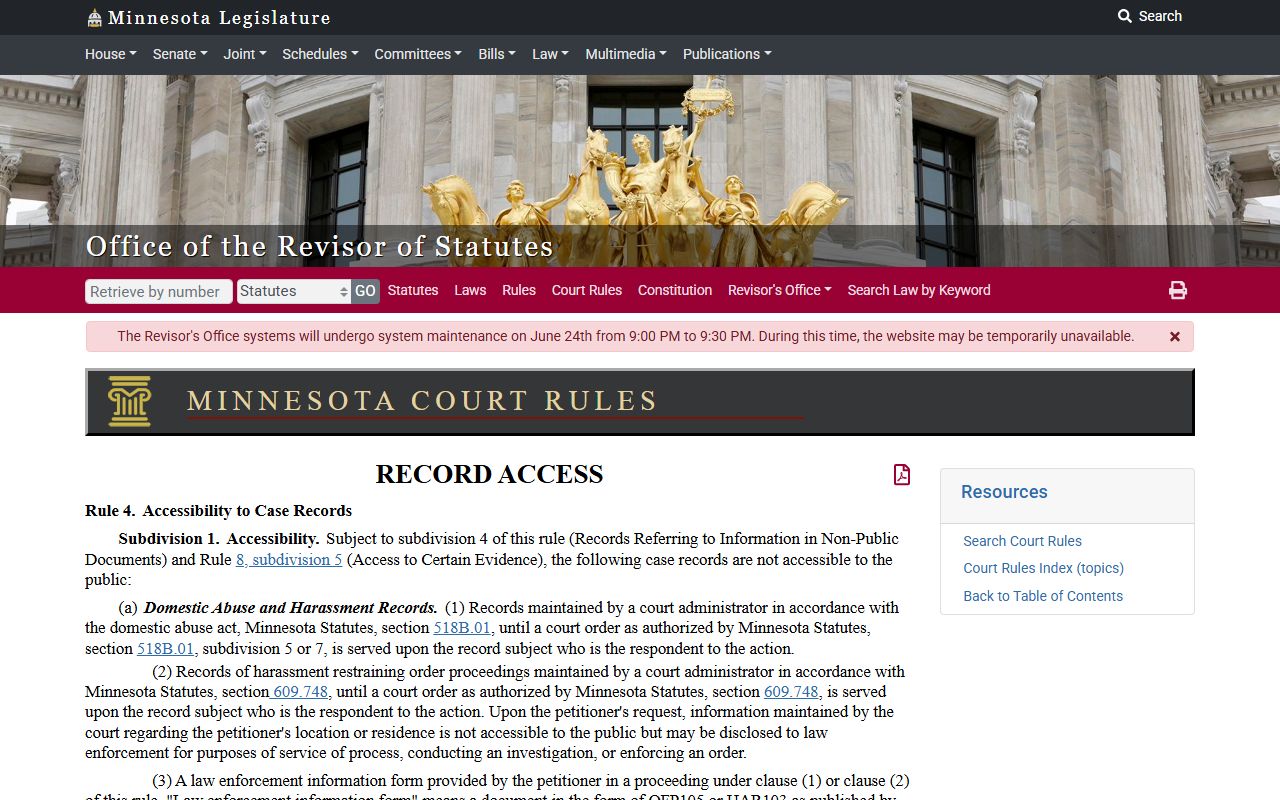
Rule-based access is why two records can both be court records, yet one appears online and another requires courthouse access or is not public at all.
For routine public records, the best sequence is MCRO first, Court Administration second. For court records that need certification, call or visit Court Administration. For county records outside the court file, use the county records office that owns the data. For federal cases, use federal court systems such as PACER. For tribal court matters, use the tribal court channel. Clear routing saves time because the same person or event can have records in more than one government system.